
Test Us All
Tucker Carlson wants to know if the Jews really belong in Israel. Fine. Run the test. It already ran.

On February 20, 2026, Tucker Carlson sat across from Mike Huckabee and suggested genetic testing to determine who among the inhabitants of the land of Israel are truly the descendants of Abraham. He phrased it as a question. It was not a question. It was an accusation with a lab coat on.

He did not suggest testing the French. He did not suggest testing the Saudis. He did not suggest testing the Irish or the Poles or the Mexicans or, for that matter, the Americans who displaced an entire continent’s worth of indigenous people and named highways after them. He suggested testing the Jews.
That selectivity is not an argument. It is the argument. The only group on earth routinely asked to prove its right to exist is the one that has been targeted for elimination for two millennia. Demanding biological proof of legitimacy is antisemitism in a research grant.
I. The Test Already Ran
Here is what Carlson apparently did not know, or chose not to mention: the genetic research has been done. Extensively. By scientists at Hebrew University, by teams publishing in peer-reviewed journals including the American Journal of Human Genetics, by population geneticists at MIT and Harvard. The findings are consistent and they are damning to his premise.
Ashkenazi Jews, the group Carlson was implicitly targeting, the Jews of Eastern Europe whose connection to the land is most frequently questioned, carry Y-chromosome haplogroups that trace directly to the ancient Levant. Approximately 20% carry J1 and 19% carry J2, both haplogroups concentrated in the Middle East and consistent with ancestry from the Fertile Crescent. The haplogroup E1b1b, found in roughly 21% of Ashkenazi men, also has significant ancient Near Eastern distribution. Taken together, the majority of Ashkenazi male-line ancestry points to the same geographic origin: the land between the Jordan and the Mediterranean.
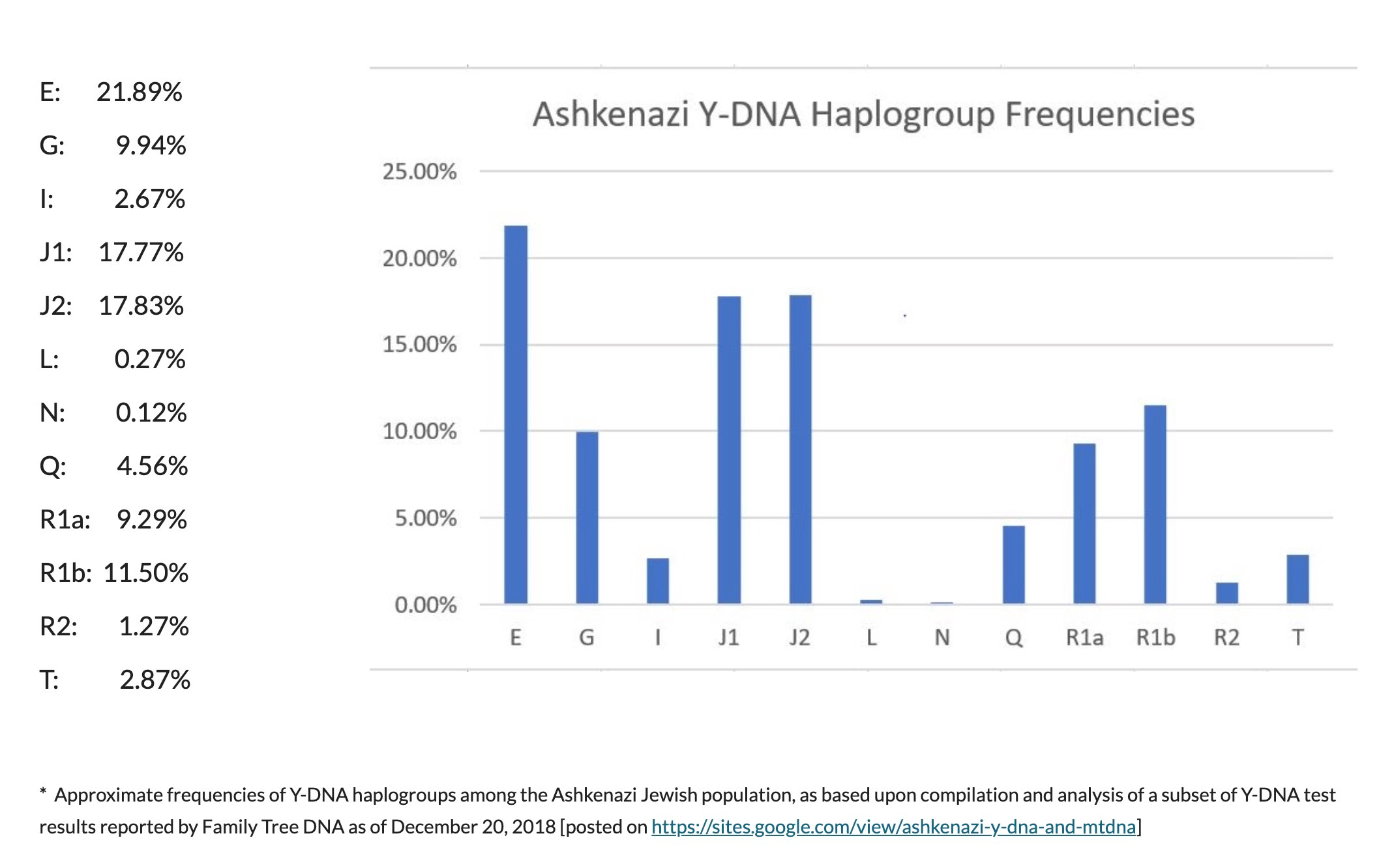
A 2010 study published in the American Journal of Human Genetics found that despite 2,000 years of diaspora across three continents, Jewish populations worldwide retained a genetic signature more similar to each other and to Middle Eastern populations than to their host populations in Europe, North Africa, or Central Asia. This is not a religious claim. This is population genetics. This is the science Carlson invited.
The test already ran. The Jews tested positive. Case closed, unless, of course, the point was never about science.
II. The Trap Inside the Question
Let us take Carlson’s premise seriously for one moment and follow it to its conclusion.
If we are to test all people and assign them to the lands their DNA points toward, we need to think carefully about what happens next. The Carlson Doctrine, genetic titling of land, would require one of the most catastrophic reshufflings of human population in history. Every American of European descent would need to leave. Every white South African. Every Australian of British ancestry. Every Latin American of Spanish descent. Every New Zealander. Carlson himself, a Connecticut Yankee with English and German roots, would be boarding a flight to Bristol.
He does not suggest this. He suggests testing the Jews. Which tells you everything about the nature of the question.
The singling out is the point. The condition itself is the discrimination. No other people is asked to produce molecular evidence of belonging. No other people’s four-thousand-year documented presence in a land is treated as unresolved. This is not a scientific inquiry. It is the oldest move in the playbook: demand the Jew prove he belongs, and if he cannot produce adequate proof, you already know what happens next.
III. Seven Wars, One Story
The DNA argument is interesting. The legal argument is interesting. But there is another argument, older and harder, written in dates and body counts.
We fought for this land. Not metaphorically. Literally.
In 1948, the day after Israel declared independence, five Arab armies invaded simultaneously. Egypt from the south, Transjordan from the east, Syria from the north, Iraq and Lebanon joining them. The new state had no air force worth the name, no artillery, no tanks. What it had was approximately 650,000 people, a third of them survivors of the Nazi genocide who had arrived with nothing, and the knowledge that losing meant annihilation. Israel won. The War of Independence cost 6,373 Israeli lives, roughly one percent of the entire Jewish population at the time. In American terms, that would be the equivalent of losing three million people in a single year of fighting.
In 1967, Egyptian President Nasser moved 100,000 troops to the Sinai, expelled UN peacekeepers, blockaded the Straits of Tiran in violation of international law, and publicly announced the intent to destroy Israel. Jordan and Syria joined the preparation. Israel struck first and destroyed the Egyptian Air Force on the ground on the morning of June 5. Six days later, the war was over. Israel had tripled in size. The world called it aggression. The people who had been promised a second Holocaust called it survival.
In 1973, Egypt and Syria launched a coordinated surprise attack on Yom Kippur, the holiest day of the Jewish calendar, when most of the country was fasting and the roads were empty. For three days, Israel came closer to destruction than at any point since 1948. The losses were staggering. The country held. The counteroffensive crossed the Suez Canal and encircled the Egyptian Third Army.
There were also the wars you don’t hear named as often: the War of Attrition from 1967 to 1970, the First Lebanon War in 1982 which aimed to destroy the PLO infrastructure that had turned southern Lebanon into a launching pad, the Second Lebanon War in 2006 against Hezbollah, two Gaza campaigns against Hamas in 2008 and 2014, and then October 7, 2023, and its aftermath.
Every single one of these wars was initiated by the decision of others to attack. Every single one ended with Israel still present. That is also a form of claim. Not a gentle one, but an honest one.
IV. We Made the Land
The Zionist pioneers who arrived in the late nineteenth and early twentieth centuries found a land that the Ottoman Empire had managed into near ruin. Mark Twain visited Palestine in 1867 and described it with his characteristic lack of sentimentality: a desolate country whose soil is rich enough but is given over wholly to weeds. A silent, mournful expanse.
The coastal plain was marshland. The Jezreel Valley, one of the most fertile regions in the ancient world, had been drained of its agriculture and replaced with swamps thick with anopheline mosquitoes carrying malaria. The death rate among early settlers was catastrophic. They drained those swamps by hand, eucalyptus tree by eucalyptus tree, ditch by ditch, across the first decades of the twentieth century. They buried their dead and kept digging. By the 1920s, the Jezreel Valley was producing grain again for the first time in centuries.
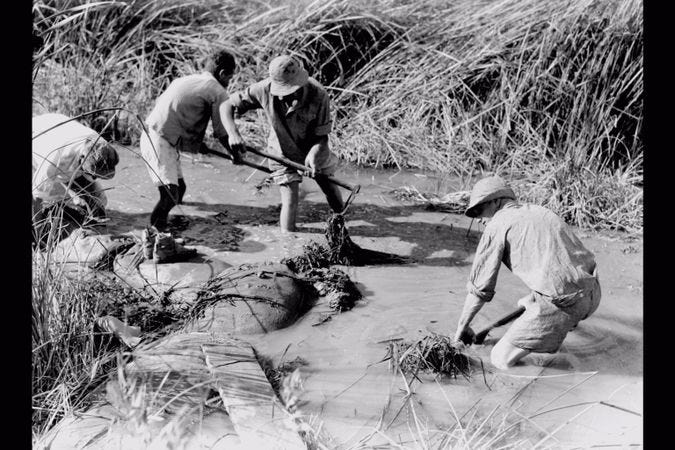
They built. From nothing, in a landscape hostile to habitation, against the active opposition of a British mandate that frequently sided against Jewish immigration even as Jews were being murdered in Europe, they built. The city of Tel Aviv was founded in 1909 on a stretch of sand dunes north of Jaffa. By 1948, it was a city of 250,000. By the 1930s, the Jewish population had established a labor federation, a university, a hospital system, an orchestra, and an agricultural research station.
This is not the story of a colonial power extracting resources and sending them home. This is the story of a people who had nowhere else to go, arriving in a landscape that barely supported life, and making it work. The swamps that once bred malaria now grow avocados and citrus for export across Europe. The desert that Twain described grows tomatoes and bell peppers through drip irrigation technology that Israel developed and now exports to forty countries.
You do not build a nation in a malarial swamp in order to visit on weekends. You do it because it is yours.
V. What We Built
Israel is, today, the most successful country in the Middle East by almost any measure you care to apply. Eight million people, a third of them absorbed as refugees with nothing from across the Arab world and from the Soviet Union. A per capita GDP roughly equivalent to France. A military that has not lost a war in seventy-five years.
The country produces more patents per capita than any nation in the world except the United States and Japan. It has more companies listed on the NASDAQ than any country outside North America. It developed the USB drive, the instant messaging platform ICQ, the Iron Dome missile defense system, a cancer-detecting breath test, and drip irrigation. Its doctors helped develop treatments for Parkinson’s disease and multiple sclerosis. Its intelligence services located and brought to justice a substantial portion of the architects of the Holocaust.
This is mentioned not to brag. It is mentioned because it is evidence of a specific kind of claim: the claim of labor, of cultivation, of making something from near-nothing. The covenant in the original sense of the word is not just the divine promise. It is also the earthly one. You show up. You stay. You build.
A Word on the Bible
The above arguments stand without scripture. They should. The case for Israel’s legitimacy does not require faith. It requires only an honest accounting of genetics, of warfare, of agricultural and industrial history.
But since we are on the subject of Abraham: the Jews have been in continuous recorded relationship with this land since approximately 1000 BCE. The texts describing this relationship are the oldest continuous literature of any people still connected to the land those texts describe. These texts are written in Hebrew. The same Hebrew you dig out of the ground, dust off, and date back 2,000 years is the Hebrew my eight-year-old son can read today. Whatever one makes of their divine authorship, their historical presence is not in dispute by any serious archaeologist.
Tucker Carlson is welcome to his DNA test. The science will return the same answer it has been returning for a century: the Jews came from here.
The question was never really about DNA.
VI. October 7 Changed the Calculation
More than at any moment since the Holocaust, we now understand with physical certainty what it means to hold this land, and what it means to need it.
On October 7, 2023, Hamas killed 1,200 people in a single morning. They were killed in their beds, at a music festival, in their children’s bedrooms. They were killed because they were Jews living in the Jewish state, and the men who killed them had announced for years that this was their intention. The world watched, and a substantial portion of it responded by questioning Israel’s right to defend itself.
That is the context in which Tucker Carlson chose this moment to suggest the Jews submit to a genetic audit.
Here is what October 7 made undeniable: even inside Israel, the most armed and prepared Jewish population in history, it happened. 1,200 people in one morning. Which means that everywhere else, in Paris, in Buenos Aires, in Los Angeles, in Berlin, the arithmetic is not better. It is catastrophically worse. The diaspora has no Iron Dome. It has no standing army. It has neighbors, and a prayer, and the goodwill of governments that have historically proven unreliable at the critical moment, and nefarious at every other.
Israel is not just where Jews chose to live. It is the only place Jews can defend themselves at scale. That is not a talking point. It is the lesson of the twentieth century, written in eight million names, and underlined again on October 7.
The connection this land represents to our dead, to our language, to four thousand years of continuous memory does not become more negotiable because someone on television decided to question it. It becomes more sacred. Threats clarify. October 7 clarified.
No commentator with a television audience and a shallow understanding of population genetics gets to determine whether the Jewish people belong in the land they bled for, built, and have held through every attempt to remove them.
We have been here. We are here. We will be here.
The inheritance is not in the blood alone. It is in the work. In the dead. In what was built from swamp and sand and stubbornness that refuses, generation after generation, to end.
Just an idiot, I am not of Jewish decent, yet raised Christian and from a little child, I was like how can they hate the Jewish people who are God's favored!
I've said it before and I'll say it again: I'm not Jewish, but I've been to Israel once, absolutely loved the place, would go there again in a heartbeat, and I totally "get" what it means to you and your people. I'm with you all the way. (And the Tucker Carlsons of the world can — as we say where I come from — get stuffed.)