
The First Echo: Why I'm Finally Breaking the Silence
How fear finds its way across generations.

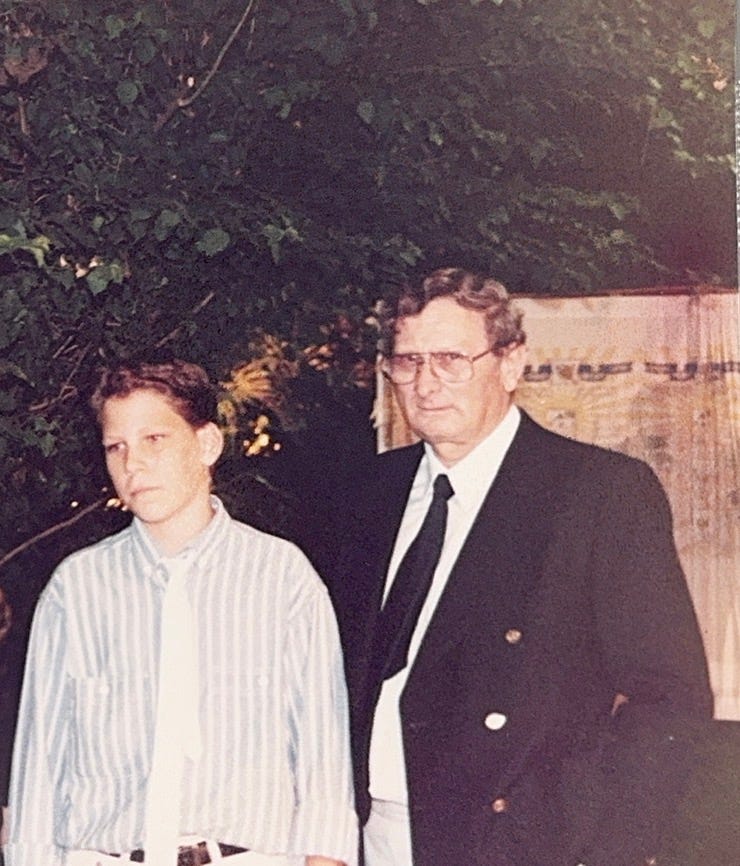
As a kid, my father hid from the Nazis.
As a kid, I hid from my father.
My wife asked me a simple question the other night:
“Why are you writing this book?”
I gave her the easy answers first.
Because it’s a story that needs telling. Because my father’s survival—false papers, Nazi-occupied Poland, the camps most of his family never left—deserves to be preserved. Because my own childhood in Israel, running to bomb shelters while sirens screamed, deserves witness too.
But those were the public answers. The real one took longer to surface.
I started digging—Holocaust archives, Yad Vashem pages of testimony, crumbling census records, concentration-camp transport lists. I found names I’d never heard, faces I’d never seen, entire branches of the family tree burned away. And somewhere in those hours of scrolling through death, I understood.
My life has been an echo.
The terror my father carried in his bones never left him. It just went quiet. He became a brilliant engineer, a math genius who could solve anything on paper but couldn’t look his children in the eye and say “I love you.” He couldn’t speak about the war, so the war spoke through him—through sudden rages, through silence that felt like a locked door, through the way fear became the family language none of us admitted we spoke.
And I learned it fluently.
I grew up hiding from missiles that might carry mustard gas, counting seconds between siren and boom, learning which bus lines were “safe” that week. When the threat ended, I did exactly what he did: I locked it away. Became the rational adult, the problem-solver, the one who never broke. Until I realized the cracks were there all along, and they had my children’s names on them.
This book is the first time I’m refusing to pass the echo on.
Writing it is the therapy I never let myself have—because who wants to relive the night a suicide bomber blew himself up twenty meters from your school gate? Who wants to sit with the memory of burying your father and then, three days later, playing the best basketball game of your life because adrenaline was the only emotion you were still allowed?
I do. Because if I don’t name it, it names them—my kids.
So this Substack is the making of When I Should Have Died.
Every Thursday you’ll get a long dispatch from the trenches: draft excerpts, research discoveries, the raw notes from therapy sessions with the past. Some weeks it’ll be my father’s story. Some weeks mine. Most weeks both, braided together the way they always were.
If you’ve ever carried someone else’s war in your body,
if silence ever felt like the safest room in the house,
if you’re ready to turn the echo into a voice—
come sit with me.
Welcome to the first break in the silence.
Hit reply and tell me: What war were you handed that you never signed up to fight?
See you next Thursday.
Wow, Ido! This is fantastic! And I've just subscribed to read future pieces! Good for you shrugging off the chains of intergenerational trauma
The ongoing war with my mother is not one I signed up for. I’m sad you share some of my turmoil. It’s interesting to read. It sounds like you were the victim of judgment and disrespect. I share those wounds deeply.