
The Thirty-Third Echo: Hannah
My mother had a sister named Hannah. She died at seventeen. My mother almost never said her name. Now my mother is gone too, and the only thing left is what she gave me.

New here?
A quick note: if you found me through my writing on Israel or antisemitism, that’s still a core part of this publication. Echoes is the more personal lane, where those public themes meet memory, family, identity, and the book I’m writing.
The sharper commentary is still on the main feed, and it remains free.
My mother had a sister named Hannah.
I know almost nothing about her. Not her voice, not her habits, not the particular way she moved through a room. I know she was seventeen when she died. I know she was the fourth oldest of eight children in a Moroccan Jewish family that had settled in Yavne’el, a small agricultural town in northern Israel. I know she was described as beautiful in the way that made people shy when they looked at her. I know she loved life. She loved the ocean.
She was heading back from the beach with friends when the car flipped.
She was not wearing a seatbelt.
My grandmother intercepted my mother at the bus station. My mother was in the army then, coming home for a weekend. Her mother was waiting for her on the platform, which was not normal, which meant something had already gone wrong before a word was spoken.
“You sister Hannah.”
My mother asked what about her.
“There was an accident.”
My mother did not break at the bus station. She asked the question you ask when you already know the answer and are asking it anyway because some part of you still believes the answer might be different.
“She’s gone.”
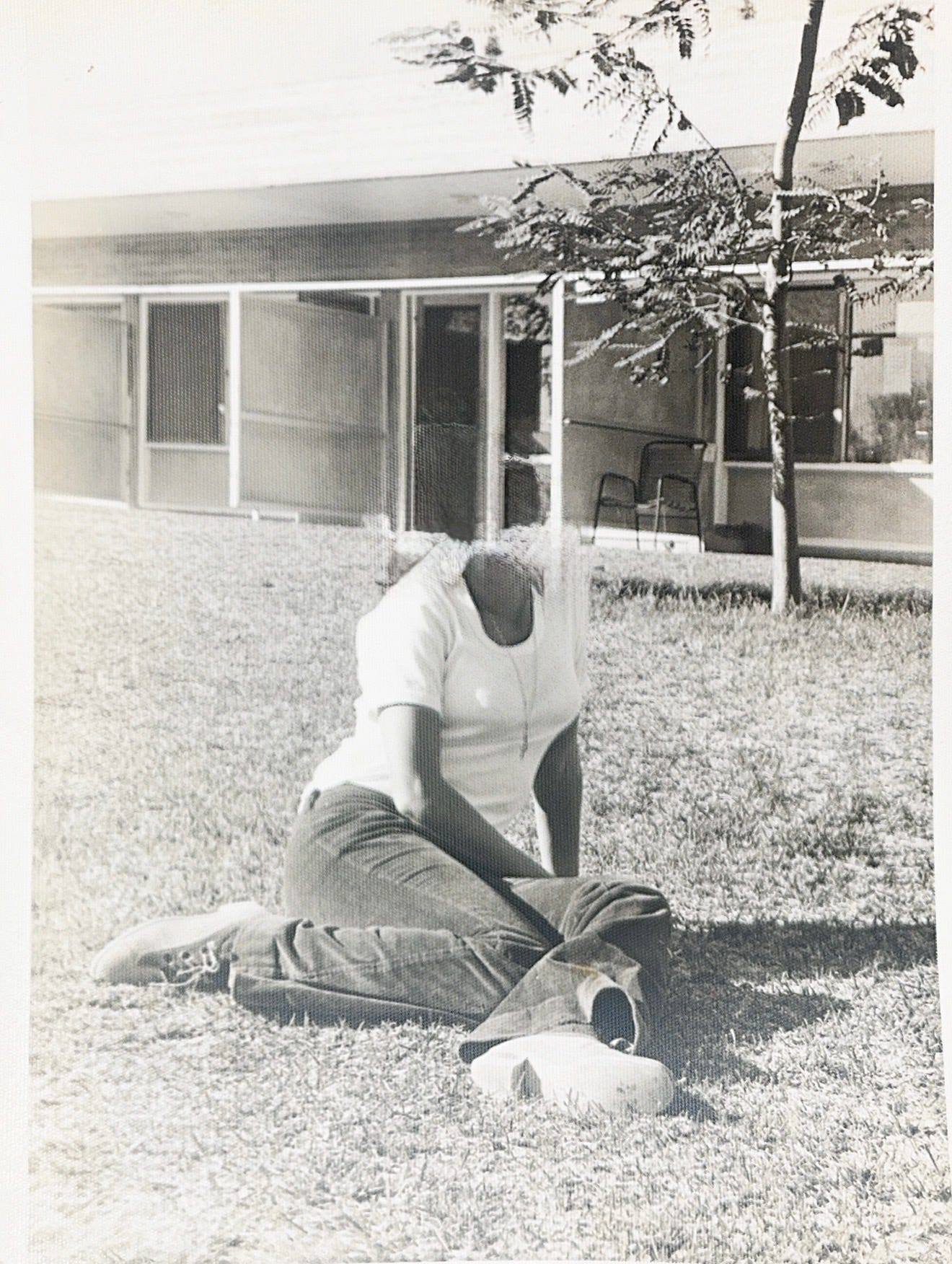
My grandmother cried the soft cry that was hard to hear and impossible not to join. My mother did not join it. She hardened. That was the word I used in the manuscript and I believe it is right. Not cold. Not closed. Hardened. The way material hardens under heat and becomes something denser and more durable than what it was before.
By morning she had decided. It was time to move to Tel Aviv.
I did not know Hannah as a person because she died before I was born. What I know of her is the shape of her absence.
My mother almost never brought her up. When the name came up, once every few years, her voice would go to a whisper and her head would drop and the subject would shift before it could fully open. I learned early not to ask. There was nothing to ask toward. Just a door that did not open, and on the other side of it, the soft cry that was hard to hear and impossible not to join, and my mother not joining it.
That silence was its own kind of information.
You inherit more from the things that aren’t said than from the things that are. The silence around Hannah told me something I couldn’t have named at eight or ten or fifteen: that loss of this kind doesn’t resolve. It doesn’t become something you made peace with. It becomes the thing you carry differently as the years go on, but never put down.
My mother put it down somewhere in the decade after Hannah died. She put it into motion. Into Tel Aviv and the tiny apartment with one window facing the sea and jazz spilling out of cafés at night. Into the fashion boutique and the hum of Dizengoff Street. Into everything that was not Yavne’el and everything that was not standing still.
When my father entered her life, she said his calm felt like a place to land.
I think she had been airborne since the bus station.
My father lost a brother too.
Michael Singer. Born 1929, died 1931. Two years old. Diphtheria. My father never knew him, was born three years after Michael died, but grew up in his room and carried his absence without knowing what he was carrying. The silence around Michael was so complete that my father never mentioned him. Not once. I didn’t know Michael existed until I was forty-four years old and started pulling records for this book.
The parallel took my breath away when I finally saw it.
Two people, my mother and my father, who each lost a sibling young. Both losses happened before the surviving child was old enough to fully process them. Both were absorbed into a family silence so total that the sibling barely existed as a subject. Both shaped the parent who arrived to me: my father into quiet and withdrawal, my mother into motion and the two words she used to hold the world together.
The mechanism was different. My father went inward. My mother went to Tel Aviv. But the origin was the same: a sibling’s death that never got a proper grief, only a silence that traveled forward in time and arrived in the body of a child who didn’t know what they were carrying.
I didn’t know what I was carrying either, until I started writing this book.
It’s ok.
I have written before about where those words came from. My mother learned them early, in a household where she became the steady one, the child who lowered the temperature before anything could tip. But I understand something now that I didn’t understand when I first wrote that piece. Hannah didn’t create the words. Hannah changed what they were for.
Before Hannah, they were a tool. A way to manage a room.
After Hannah, they became a way to manage herself.
She turned them inward first, in the days after the bus station, in the months she spent becoming someone who could carry what had happened and still get on a bus to Tel Aviv and still rent an apartment and still work and still be in the world. She practiced the words on herself before she ever gave them to anyone else.
Then she gave them to us.
I don’t know what Hannah would have become. She was seventeen. She had a lot of friends. She loved the ocean. She was the kind of beautiful that shifts a room. She might have stayed in Yavne’el or she might have followed my mother to Tel Aviv or she might have gone somewhere neither of them imagined. She was about to graduate high school. She was at the beginning of whatever came next.
She never got to whatever came next.
I think about that sometimes. Not with grief exactly, because you can’t grieve someone you never knew. With something closer to vertigo. The awareness that the world is full of people who almost existed, who were heading somewhere and then weren’t, and that the ones left behind carry the heading without arriving.
My mother carried it all the way to Tel Aviv. All the way to my father and the twenty-year age difference that seemed not to matter because he felt like a place to land. All the way to me and my sister. All the way through a lifetime of not saying the name unless it was pulled out of her, and even then only in a whisper with her head down.
She never recovered. I could see that as a child without knowing what I was seeing. Some losses don’t resolve. They become the thing you organize the rest of your life around without naming what you’re organizing around.
My mother died a year ago.
I am writing this piece now, after losing her, and I find that the grief I feel for her and the grief I cannot feel for Hannah have become entangled in a way I didn’t anticipate. I knew my mother. I loved her. I watched her carry what Hannah’s death had done to her for my entire childhood without ever fully understanding what I was watching. Now she is gone too, and the only version of her that remains is the one she gave me: the whispered “it’s ok,” the steady presence, the words that held the room together when nothing else could.
She carried Hannah’s absence for sixty years.
She never put it down.
She said “it’s ok” to me ten thousand times instead.
I think that was the same sentence.
Just translated into something a child could hold.
This is one of many Echoes from the book I’m writing.
Fragments of a larger story about survival, inheritance, and identity.
If you want to be among the first to know when it’s ready, you can join the early reader list.
If you want to simply follow along it as it comes together, you can subscribe.
Everything I’m writing lives on the feed.
Most readers find me through my Notes.
This is where the Notes find their roots.
"You inherit more from the things that aren't said than from the things that are." This sentence is a perfect work of art: simple, profound, a distillation of a human truth that reaches across borders and centuries. I treasure it. If it doesn't seem presumptuous to say, it speaks almost too perfectly to my own family's unspoken Diaspora histories. Thank you!
Tell you whst, Ido, this piece speaks volumes about inherited trauma. Tnx for writing it. I've just discovsred something enormous about one of my own forebears that's blown me upside down. It's not just grief, loss, fear that we inherit but mortal sin from situations that are inescapably inbred. I bet you have a potential prize-winning best-seller here. 🙏🙏🙏🙏